
 Facebook
 X
X
 Pinterest
 Copy Link
Market Insights: March 2023





Jill Vail
REALTOR®
Owner, Designated Broker, Windermere Stanwood & Camano Island
360-387-HOME
.
8 Tips for First Time Home Sellers

You’ve seen “For Sale” signs around your neighborhood, but what does it take to actually put your home on the market? First-time home sellers often enter the selling process unaware of what’s to come, their heads full of questions. Understanding the selling process will inform your conversations with your real estate agent and will help you stay organized and on schedule as you sell your home for the first time.
8 Tips for First-Time Home Sellers
1. Know the Costs of Selling a Home
Though you’ll eventually walk away from the sale of your home with a lump sum in your pocket, the selling process isn’t without its costs. Real estate agent commission costs typically account for five to six percent of the sale price, but they’re not the only expense you’ll encounter on your selling journey. Between repairs, home upgrades, staging, escrow fees, Capital Gains Tax and more, it’s important to budget for these costs before listing your home.
2. Find the Right Agent
A successful selling experience starts by working with a professional real estate agent. Real estate agents specialize in keeping up with local market conditions, they have the tools to competitively price your home, and they understand what is driving buyer interest in your area. But beyond these qualities, it’s important that first-time home sellers choose an agent who understands their goals and cares about their happiness. Selling a home can be an emotional roller coaster and having a trusted expert beside you will help you navigate its ups and downs.
3. The Importance of Home Staging
Whether you hire a professional or decide to stage your home yourself, what’s important is that you make the commitment. Staging your home creates universal appeal, capturing the attention of the widest possible buyer pool. If your interior is too personalized, it makes it harder for buyers to see themselves in your home. Staging makes financial sense as well, as it often equates to higher sales prices. According to a 2020 survey performed by the Real Estate Staging Association (RESA®), of the 13,000 homes surveyed, 85% of staged homes sold for 5-23% over list price.1
4. High ROI Remodeling Projects
Remodeling projects cost a significant amount of money; there’s no way around it. This is where your agent’s expertise can help you spend wisely: they can inform you of which home features and upgrades are driving buyer interest in your area. Target the high ROI remodeling projects that increase home value to get the most bang for your buck and know which remodeling projects to avoid when selling your home.

Image Source: Getty Images – Image Credit: Hispanolistic
5. Pre-Listing Inspection
Anything that could potentially give your home a competitive advantage over other listings is worth discussing with your agent. One such strategy is conducting a pre-listing inspection before putting your home on the market. Not only do pre-listing inspections give sellers a better understanding of what repairs may be in order, but they also streamline the selling process by transparently disclosing the details of a property’s condition to the buyer. These reports are especially helpful in competitive markets, since buyers are more likely to waive inspections.
6. How to Price Your Home
Of all the information coming at you during the selling process, you’ll likely have your mind set on getting the best price for your home. Determining home value is one area where real estate agents excel; their Comparative Market Analysis (CMA) will help them set an accurate and competitive figure. It’s important to separate your emotional attachment to your home from your agent’s calculations. In your mind, your home possesses a certain value, but that may not match what it can realistically fetch on the market. Sometimes it may be even more than you thought!
7. Safety Tips for Open Houses
The more buyer interest you’re able to drum up, the better. Open houses play an important role in the selling process in that they allow buyers to experience the property firsthand. Making this connection requires opening your doors to strangers, which is cause for taking the appropriate safety measures. Remove all prescriptions from your medicine cabinets, lock up precious belongings and personal information, make sure all doors and windows are locked at the end of each day, and discuss your buyer screening process with your agent so you’re on the same page.
8. Moving Timeline
The planning doesn’t stop once you’ve sold your home. Before the ink is dry on your real estate contract, your gears will be turning about how to efficiently move into your new home. We’ve created an interactive Moving Checklist with a step-by-step guide to the moving process, from twelve weeks before moving day all the way up until you make your move. The list is also available as an interactive web page and downloadable PDF here:
For more information on the selling process from list to closing, visit our comprehensive selling guide here:
Written by Sandy Dodge
1: Real Estate Staging Association (RESA®). “The Consumer’s Guide to Real Estate Staging.” Realestatestagingassociation.com. 2020.
Selling Your Home in a Balanced Market

Your local market conditions dictate the real estate climate around you. Where things are on the buyer’s/seller’s market spectrum will impact how you and your Windermere real estate agent approach selling your home. As a part of this process, it’s important to understand the different types of markets and how their conditions play into accurately pricing your home.
See the latest data on home sales, home prices, mortgage rates and more for your area here:
What is a seller’s market?
The housing market is categorized as a seller’s market when demand for homes is greater than the supply on the market. With limited inventory, competition is high amongst buyers. This drives home prices up, decreases days on market, and often leads to multiple offers from buyers. These are ideal conditions for selling your home, given that buyers are forced to continually sweeten their offers to win out. For example, buyers are often more apt to remove contingencies from their offers in a seller’s market.
What is a buyer’s market?
A buyer’s market is on the opposite end of the real estate market spectrum. It is usually defined as having six or more months of available inventory—meaning if no new homes were listed, it would take six (or more) months for all available listings to sell.
Because there’s greater supply than demand, there’s less competition among buyers, and it’s the buyer’s agents who often have the leverage during negotiations. Selling in these conditions emphasizes the importance of investing in improving your home before putting it on the market.
Selling Your Home in a Balanced Market
A balanced market exists in equilibrium between a seller’s market and a buyer’s market. It is the middle part of the Venn diagram between the two; it shares certain aspects of each, but only dips its toes into both.
When your local real estate market is balanced, it’s important to approach the selling process with a realistic mindset. In a balanced market, bidding wars are less likely and the chances of buyers having complete leverage are slim. These conditions, however, are all the more reason to make your home stand out amongst competing listings. Making repairs, remodeling, and boosting curb appeal can all help attract buyers while increasing the value of your home.
When coming out of a seller’s market, it’s important not to panic when your local real estate market experiences a cool-down or a return toward balance. In a balanced market, there are still plenty of buyers actively seeking homes, albeit at a lesser pace. Even as aggregate home sales decline and days on market increase, these market conditions should not be confused with more extreme situations like the housing market crash of the late 2000s.
Our Chief Economist Matthew Gardner covers recent housing marketing conditions as they compare to the Great Recession. Read his analysis in two recent articles:
Working With an Agent to Sell Your Home
All these factors highlight the importance of working with your agent to accurately price your home in a balanced market. Real estate agents have access to the Multiple Listing Service (MLS), which gives them access to a huge network of data on available homes both present and historical. They’ll use this data to conduct a Comparative Market Analysis (CMA) to competitively price your home. To get started, connect with a local, experienced Windermere agent:

Market Insights: February 2023

February 2023 in Stanwood and Camano Island showed upticks in new listings and pending sales compared to January. Based on the activity, it appears that a degree of balance is returning to the market.
New Listings: There were 66 new listings added to inventory last month, 38 in Stanwood and 28 on Camano Island. This is only 1% fewer than 12 months ago.
Pending Sales: Volume of pending sales increased 14%, from the year-ago total of 51 to 59.
Homes Sold: Year over year closed sales declined 22% from 47 to 37 transactions.
Sale Price: Average sale prices in Stanwood and Camano Island slipped 10% and 17% respectively from last February.
SELLERS – There will most likely be a shortage of inventory this spring, but the Buyers are out there! Multiple offers are being seen on the right properties despite the interest rates. Price is important. If you are thinking of listing your home, meet with your local agent to discuss market value and additional value they can bring.
BUYERS – Get pre-approved for a mortgage now. This will give you a better idea of your budget and price range to focus on. Be patient! The current market is still a bit competitive, so it may take some time to find the right home at the right price. Hire a local agent who knows this area and market well.
At Windermere, our responsiveness to the local market, dedication to the community, and commitment to our trade is why we help our clients buy and sell more real estate in Stanwood and Camano Island than any other company.
We are all in, for you.
.


Marla Heagle
REALTOR®
Managing Broker, Windermere Stanwood & Camano Island
360-387-HOME
.
Homeownership Terms to Know: Pre-Approval, Pre-Qualification & More

Throughout the home buying process, you’ll encounter several checkpoints. At every stop, you’ll get closer to the ultimate goal of purchasing your next home. Each one satisfies unique criteria required to become a homeowner, and each one has its own terminology. Before you begin your home buying journey, it’s helpful to know about pre-approval, pre-qualification, and proof of funds, and the role they play in a real estate transaction.
Pre-Qualification and Pre-Approval
What is pre-qualification?
Pre-qualification and pre-approval go hand in hand, but one precedes the other. Pre-qualification is a very early step in the home buying process leading to pre-approval. After sharing your financial information with your bank or lender, they’ll give you an estimate of the loan amount you can expect to qualify for. During this time, you’ll learn about the different home loans available to you to help you decide which is best. Pre-qualification usually only takes a few business days.
What is pre-approval?
A sibling to pre-qualification, pre-approval takes things a step further. Once you submit a mortgage application, you’ll provide your lender with the required information to perform a financial background check to assess your creditworthiness. You’ll get a pre-approval letter showing the lender’s offer of a specific loan amount, so you’ll know how much you can borrow. You’ll also get a better understanding of what interest rate you can expect to pay on your loan. Mortgage pre-approvals are typically valid for 60 to 90 days.
More information on the benefits of pre-approval and when to get pre-approved:
Once you’ve gone through the pre-approval process, it’s helpful to know which homes you can afford. Use our free Home Monthly Payment Calculator by clicking the button below. With current rates based on national averages and customizable mortgage terms, you can experiment with different values to get an estimate of your monthly payment for any listing price.

Image Source: Getty Images – Image Credit: Thitiphat Khuankaew
What is a proof of funds letter?
Simply put, in real estate, a proof of funds letter is a document that proves to the seller that you have enough money available to purchase the home. Proof of funds letters may vary depending on the terms of the transaction. For example, if you’re making an all-cash offer, your letter will prove that you have enough liquid cash to complete the deal.
For more information on the home buying process, read our blog post on searching for a home:
How to Search for a Home: Buying Guide
Windermere Chief Economist Shares Local Predictions for 2023
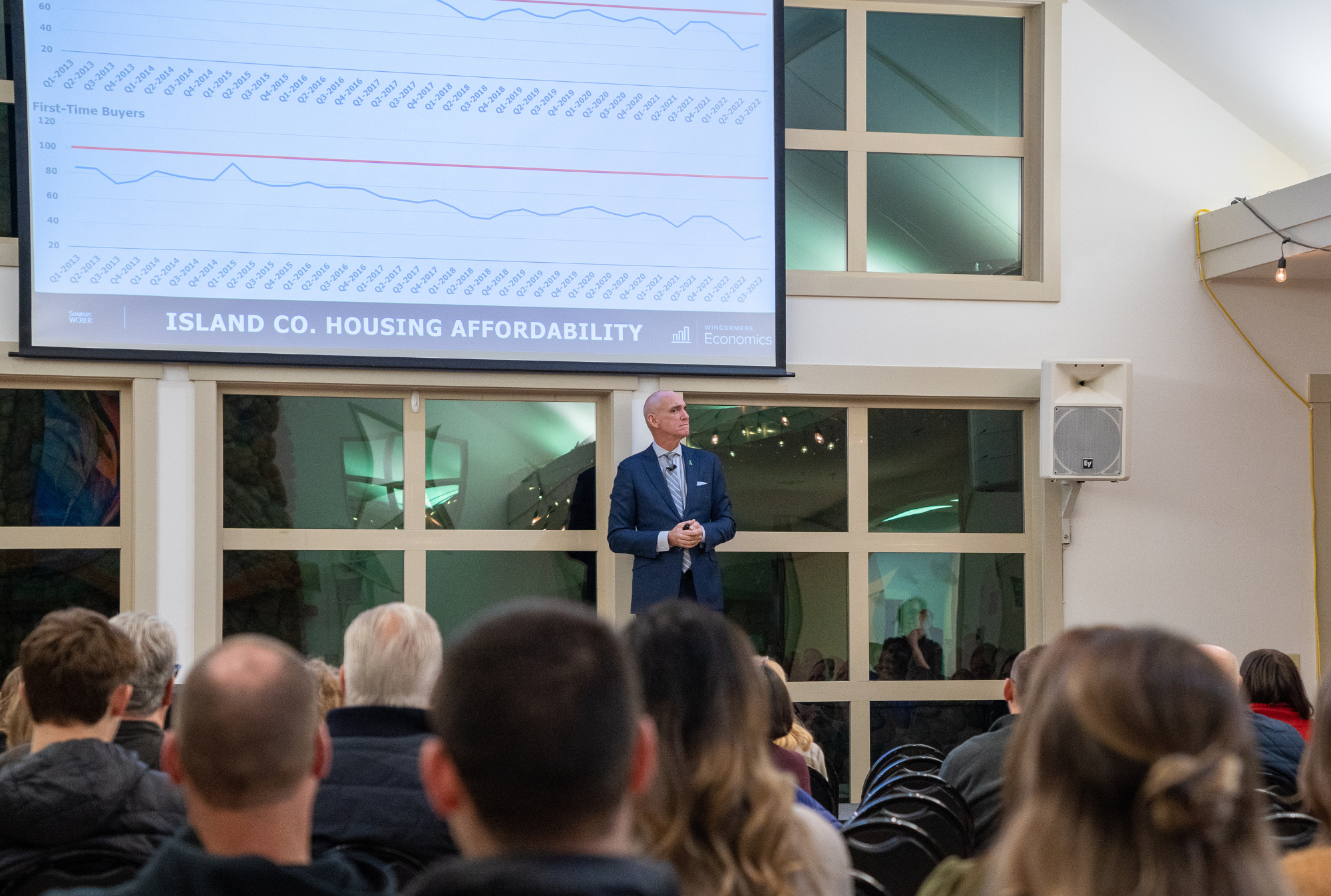
Matthew Gardner, Windermere’s Chief Economist, joined us at the Camano Center where he delivered his 2023 forecast for Stanwood and Camano Island. He provided an in-depth look at the local market and highlighted key trends that will impact the area’s housing market over the next few years. His forecast provided essential insight into where Camano Island’s real estate industry is headed – and what potential buyers and sellers need to know.
In the current economic climate, the cost of living can be a significant burden for many. However, recent developments are suggesting that inflation might be on its way down across the board. This is in part due to falling gas prices, which have decreased dramatically over the last few months. According to Gardner, this trend is heading in the right direction; however, it isn’t happening as quickly as consumers would like.
“I contend that the FOMC waited too long before starting to shift their policy stance and that they will continue aggressively raising rates for longer than necessary due to inflation, which will likely result in a recession,” Gardner went on to say, “The Fed is still willing to risk a recession to bring inflation to heel and a “modest” contraction is now baked into economists’ forecast”
What does this mean for our local market in Stanwood and Camano Island?
“Rates averaged 3.11% in 2021 but the Fed withdrawing much of their support led them significantly higher – peaking at over 7% in 2022 before starting to yield” Gardner shared, “I believe that rates peaked last quarter with inflation slowing and bond yields pulling back rates will slowly trend lower as we move through 2023.”
But Matthew Gardner isn’t the only one to predict this. When comparing his predictions with those of other analysts’ expectations no one is predicting rates to rise further with their end-of-year mortgage rate predictions ranging from as low as 5.2% up to 6.4%.
When looking at sale prices on homes in our communities Gardner expects prices to reduce. Buyers are again negotiating and sellers must adjust to that shift in the market. Although there has been a pullback in those prices Gardner cautions us not to worry but to recognize that the prices are correcting after the artificial conditions created by the pandemic. “Prices are correcting but are unlikely to fall much further before they start to stabilize and then returning to the long-term trend in price growth,” Gardner shares.
“I expect that 2023 will be a year of transition,” Gardner concluded. “It may feel rough, but this is actually a good thing and will allow a more stable market to return!”
At Windermere, our responsiveness to the local market, dedication to the community, and commitment to our trade is why we help our clients buy and sell more real estate in Stanwood and Camano Island than any other company.
We are all in, for you.
Take a look at Matthew Gardners Recent Blog: 2023 Real Estate Forecast: Why This Market Won’t Be Like 2008

