
 Facebook
 X
X
 Pinterest
 Copy Link
Market Insights | May 2021

MAY 2021 was an active month in the Stanwood, Camano Island market. 95 residential listings were added in our zip codes 98282 and 98292. This is slightly fewer than May of 2020, when 104 new listings were added.
However, 87 residential homes sold during the month of May with an average sale price of $686,681, an average of 7% over list price. The average price per square foot was $344.
May Pending sales continued at the same pace as April, keeping inventory low. There were 89 pending sales in Stanwood and Camano Island.
Year over year price increases on the 418 residential closed sales in 2021 soared 21% from a year ago for our combined zip codes.
With more listings hitting the market, some sellers who have been pushing the envelope on their listing prices are now experiencing longer list times and, in some cases, have had to drop their prices.
That said, there is still far more demand than supply. Only a decrease in demand will truly moderate house price trends. We predict a high volume of pending sales activity continuing into the summer.
At Windermere, our responsiveness to the local market, dedication to the community, and commitment to our trade is why we help our clients sell more real estate in Stanwood and Camano Island than any other company.
We are all in, for you.


Windermere Real Estate Designated Broker | REALTOR®
Owner, Windermere Stanwood & Camano Island
360-387-HOME
.
Selling a Home with Pets

For pet owners, it’s hard to imagine their home without a furry friend. However, when it comes time to sell, showcasing the qualities of a home should take precedence over the pets that live in it. This creates additional steps in the process of preparing your home for sale, but it makes all the difference in the minds of buyers.
Staging Your Home
A well-staged home makes it appealing to the widest variety of buyers and has significant ROI potential when it hits the market. However, having a pet can complicate the staging process. Buyers may lose interest in the home if they see traces of pets, so it’s a good idea to hide any and all signs of their presence.
It’s especially important to hide evidence of your pet in marketing photos. Prepare for your home’s listing photos by cleaning and vacuuming, making sure all pet stains are gone and any pet-related damage is repaired. Stow any pet carriers, cages, toys, food bowls, and other supplies that may hinder the photographer’s ability to capture the essence of a room.
Showing Your Home
Before inviting potential buyers inside, it’s best to give your home a deep clean to improve your home’s air quality, and to rid your carpets, flooring, and surfaces of pet odors and any dirt they may have tracked in over time. If you’re using your own furniture, vacuum and clean everything to extract as much fur and pet dander as possible. Talk to your agent to see if it’s a better idea to stage your home with rented furniture. If your pets have caused any damage in the home, make repairs or replacements as needed. After tending to your home’s interior, don’t forget to clean up after your pets in your yard as well. Fill in any holes in the lawn, freshen up your flower beds, and tidy up any areas of the landscaping where your pets may have dug.
After you’ve prepared your home for showings, there’s the question of what to do with your pets once buyers actually start taking tours. Ask a family member, friend, pet sitter, or neighbor to watch your pets while the showings take place. If you’re not able to find someone to watch them, form a strategy to temporarily relocate your pets during showings. If they must stay in the home, garage, or backyard during tours, it’s best to give buyers advanced notice that there are pets on the property. Talk to your agent about posting signage communicating their presence so that there are no surprises as guests make their way through the house.
Taking all these precautions will help to present your home in the best light without detracting certain buyers, for whom the signs of a pet may cause them to lose interest. On the other hand, if any buyers inquire about how the home can accommodate their pet, you and your agent will be more than ready to answer any questions they may have.
Selling Your Home
For more information on the process of selling your home, visit the Selling Page on our blog. To get an idea of what your home is worth, try our free home value calculator below:
What’s My Home Worth?
By Sandy Dodge
7 Weekend Home Projects

So many projects, so little time. That tends to be the mantra for homeowners with an ever-growing to-do list and limited availability to accomplish their tasks. Fortunately, the weekend is an opportunity to dig into certain projects and see them to their completion by the time the weekdays come around again. These seven weekend home projects can be accomplished within a couple of days and will make a dent in your to-do list.
1. Upgrade Your Kitchen Cabinets
Giving your kitchen cabinets a facelift is a simple way to give your kitchen a makeover. When staining wood cabinets, begin by removing the cabinet doors and hardware, then wipe the doors to clear away and dust and dirt. After applying and removing wood stripper, sand the doors to get them primed and ready for a new stain. When painting cabinets, choose a color that works well with your appliances. As you pack up the contents of the cabinets keep your most frequently used items nearby so you can access them during your project. To add a finishing touch to your weekend cabinet makeover, shop around for new hardware and drawer inserts.
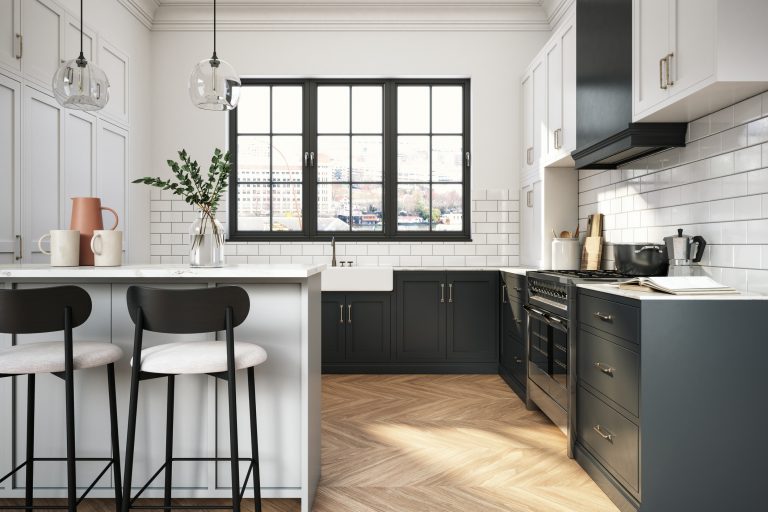
Image Source: Getty Images
2. Refresh Your Front Entry
Your home’s front entry is the key to making a lasting first impression and helps to enhance your curb appeal. Make a statement by giving your front door a fresh coat of boldly colored paint, look for stylish house numbers, and add classic front entry elements like a sitting bench or swing for ultimate comfort.
3. Improve Your Home Office
Whether you work remotely or in person, much can be done in a weekend to improve the functionality of your home office. Creating an environment conducive to your productivity helps to separate your office from the rest of your home, maintaining a balance between your work life and your home life. Situate your desk near a window to attract natural light. If the room has no windows, orient your seating so you’re facing the open space of the room. Experiment with therapy lights, ergonomic chairs, and soothing décor to make your office as comfortable as can be.
4. Curate Your Bathroom
In one weekend your bathroom can be transformed into a sanctuary of self-care. Refinishing your tub is a cost-effective alternative to a replacement. Start by removing any and all hardware, then sand the whole surface, filling in any cracks or holes with putty. Once you’ve sanded down the putty, apply multiple layers of primer and topcoat following the manufacturer’s instructions and buff the surface. Replace your vanity’s cabinet hardware and drawer pulls, matching them with your shower rod, faucet and shower head to tie the room together. Switch out your shower curtain and carpets for bold colors to liven up the space or choose neutral tones to create an organic feel.
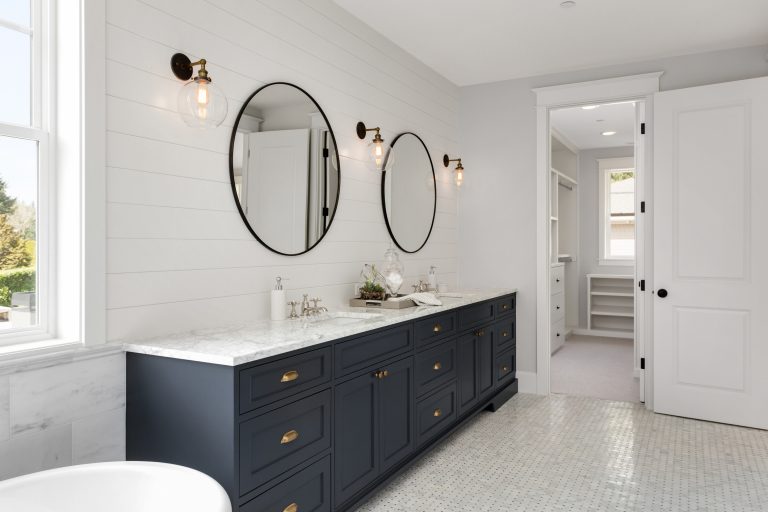
Image Source: Getty Images
5. Organize Room-By-Room
Spending a weekend organizing each room of the house is sure to make a big difference in the look and feel of your home. Bookcases and coffee tables are magnets for clutter in the living room. Start by emptying everything and sort the items into three piles: keep, dispose, donate, (this method of organization will do wonders for your closets and bedroom as well), and invest in storage bins to keep the space tidy. In the bathroom, organize the medicine cabinet and vanity drawers first. Get rid of expired medication, makeup, and toiletries. Take the same approach to your shower. Once you’ve gone through everything, reassess your shower shelving to fit your newly organized inventory. After working your way through your kitchen cabinets, consider either a hanging or wall-mounted pot and pan rack to save space.
6. Fix Up Your Fence
Whether your fence needs a simple wash, a new sealant or stain, or repair, tending to it will freshen up your yard while also extending the life of your fence. Power washers are a helpful tool in getting your fence clean before re-staining, but a sprayer that’s too powerful could damage the wood. Let the fence dry for one to two days before applying the stain. As long as any damage that needs repair is contained to a section of the fence, a weekend should be plenty of time to get it fixed. To replace any damaged rails, pry them off their posts with a crowbar or cut the damaged section out with a handsaw. When repairing fence posts, be sure to remove any rails that are connected to it.
7. Build a Firepit
Common firepit materials include brick, stone, or cinder blocks. Outline your firepit before you start digging. Once the hole is dug six to eight inches deep, fill in the hole with gravel until it is level with the ground. Choose your materials, fix the stones into the ground, compact them together, and enjoy your time by the fire. Check for local burn bans or regulations.
Written By Sandy Dodge
Blue Ridge midcentury modern goes on the Seattle market for first time ever
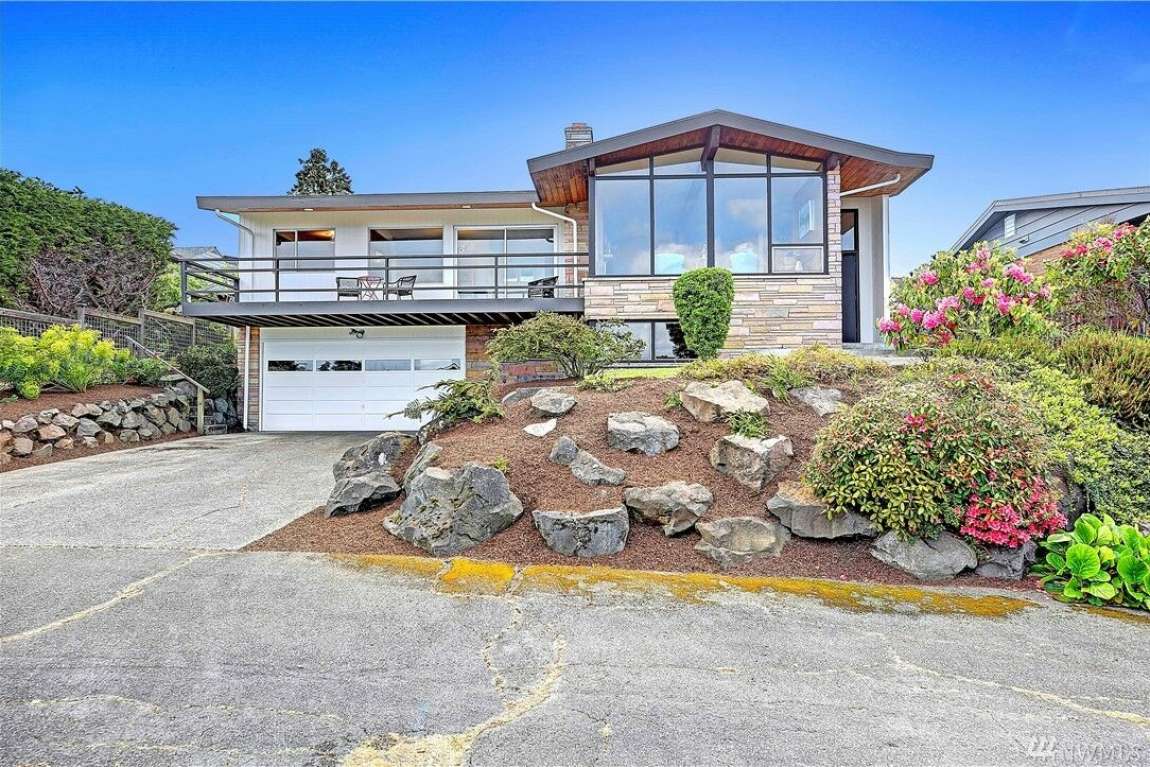
Built in 1959, only one family – the architect’s own – has ever lived here

This Seattle midcentury modern is a time capsule of the most delightful nature. Designed and built by an architect for his own family in 1959, this is the first time 2425 N.W. Blue Ridge Drive has been on the market … ever.
The classic midcentury lines of the home are the work of Architect Norman Overland. Overland built the home for his wife, Rosina Mary Overland, and it is in this home that the couple raised their two daughters.
According to the original blue print sketch, Overland envisioned the 2,200-square-foot abode exactly as it appears now. The signature angularity that defines midcentury modern design – as well as generous use of the wood and glass – create a gorgeous frame for the home’s setting, offering views of Edmonds, Kingston, Whidbey Island, and the Olympics.
The sense that Seattle’s most stunning nature is right outside is more than just an effect of Overland’s midcentury aesthetic. The home is located within the Blue Ridge community, with a private park, pool, and beach access just steps away.
Your chance to be the second-ever owner of this historic, preserved home comes with a price tag of $1.113 million. Touring it, however, is free: just scroll down.
The home is frozen in time, a classic late ’50s midcentury modern overlooking the water.
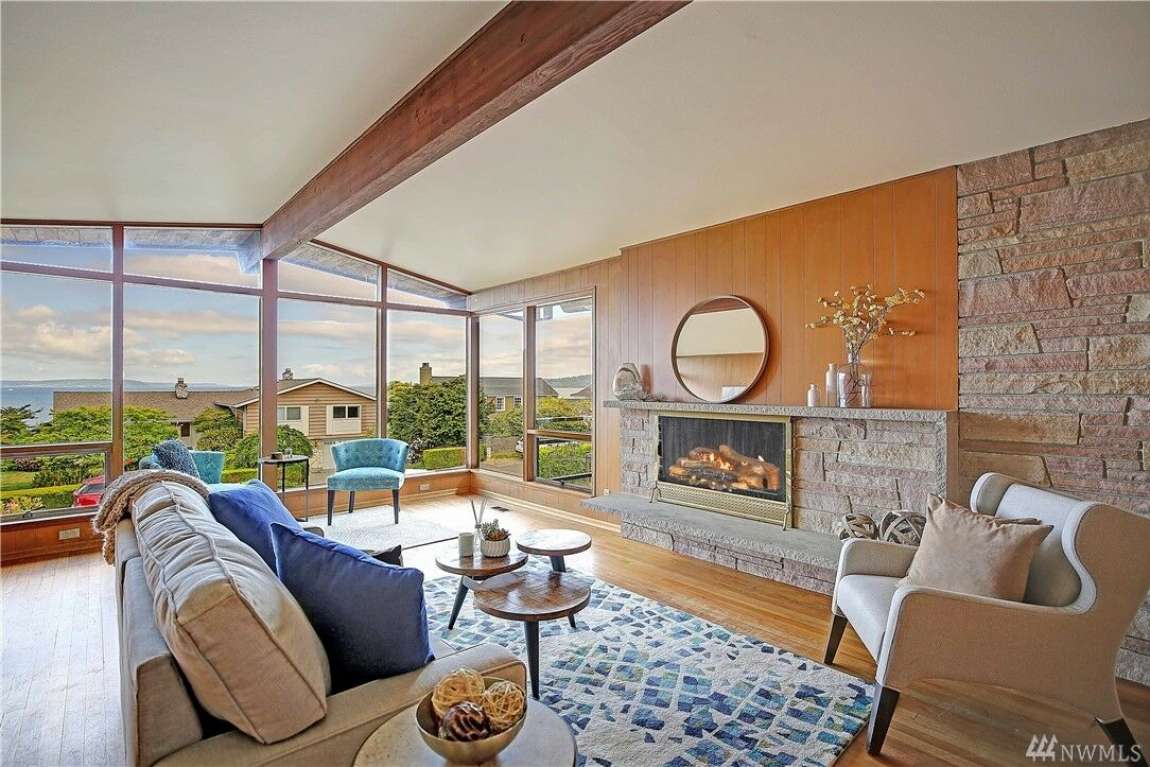
Inside, we see midcentury hallmarks: beamed ceilings; a large stone double-sided fire-place anchoring the wood paneled living room; and dining room on other side.
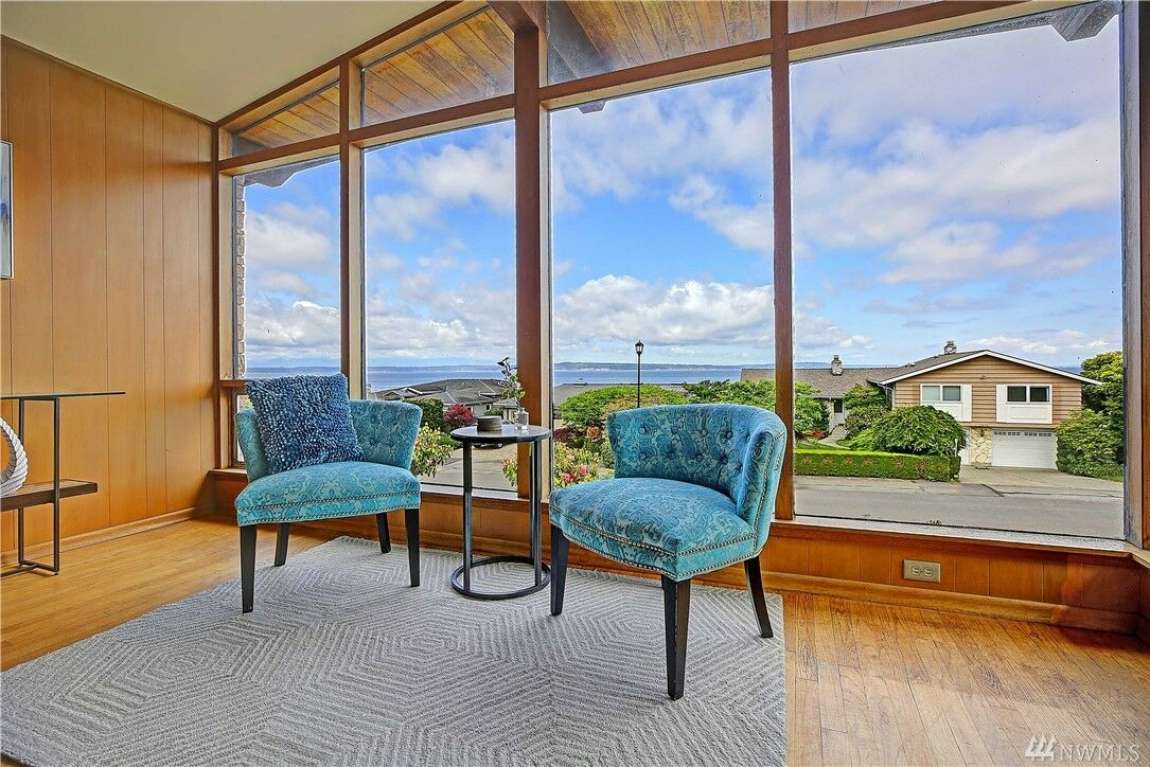
Stunning views abound in this house, framed by floor to ceiling glass here in the living room.
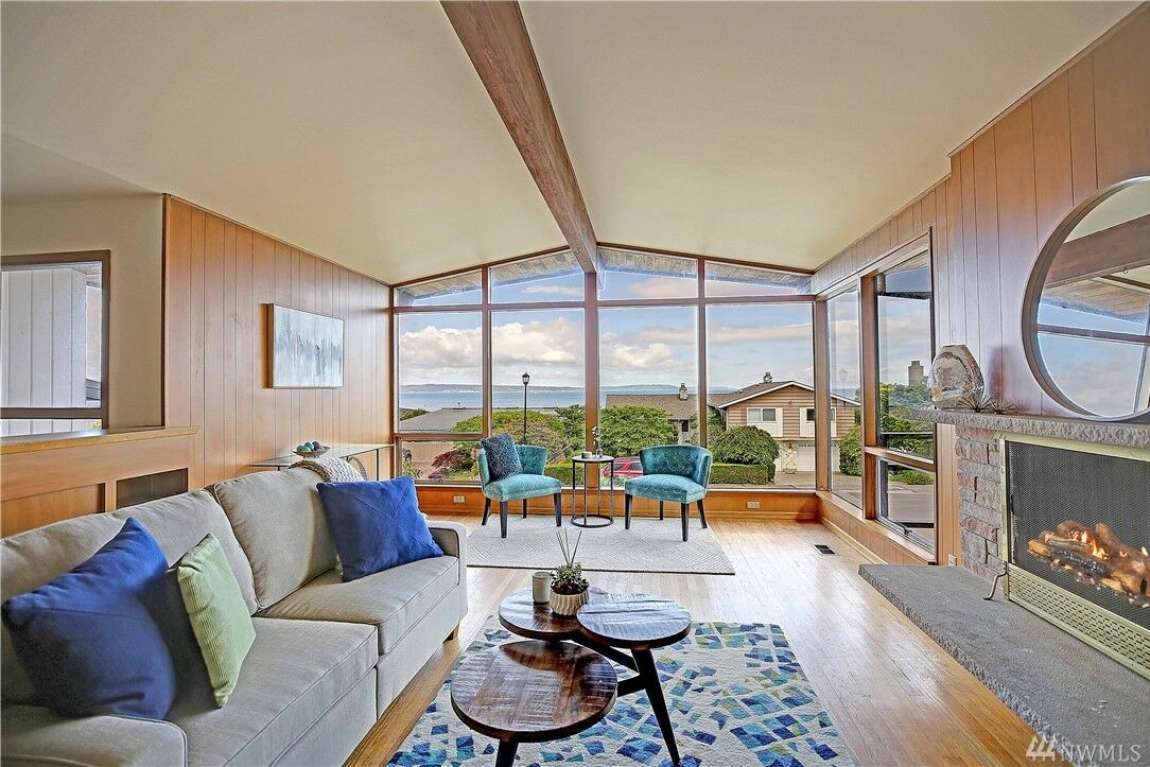
Main level living with masterful planned living room.
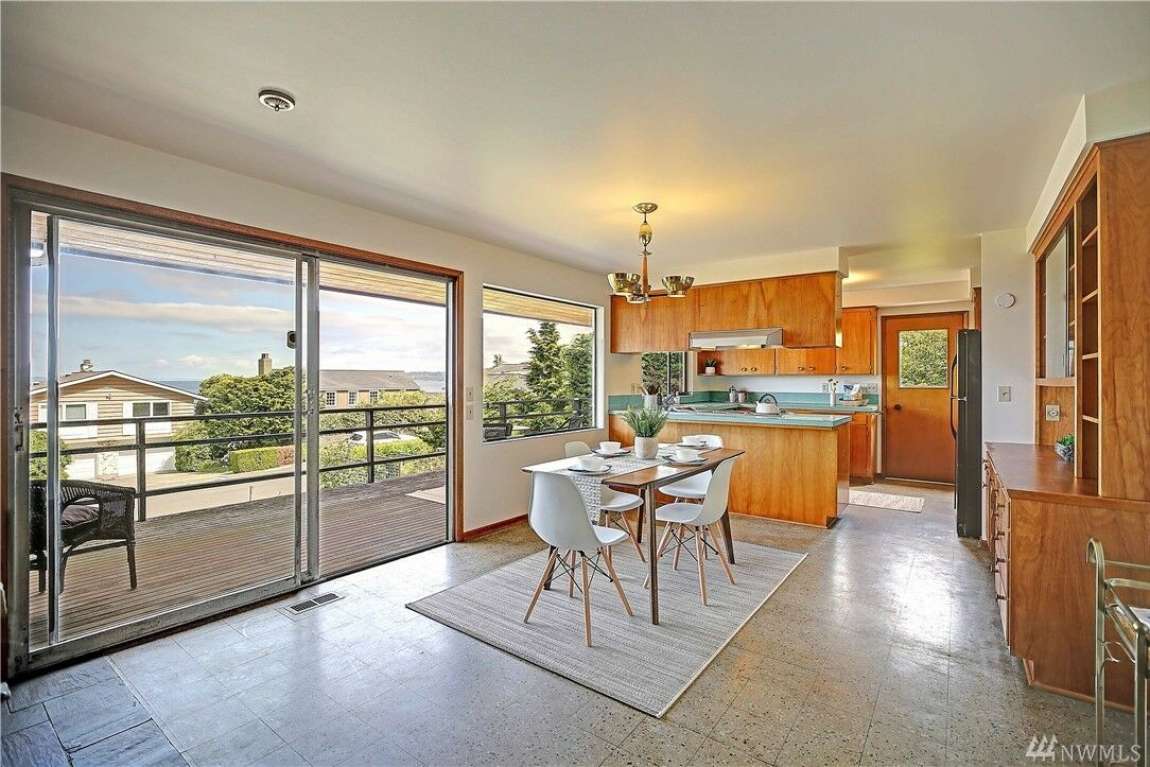
The dining area offers easy, intimate access to both the kitchen and the outdoors.
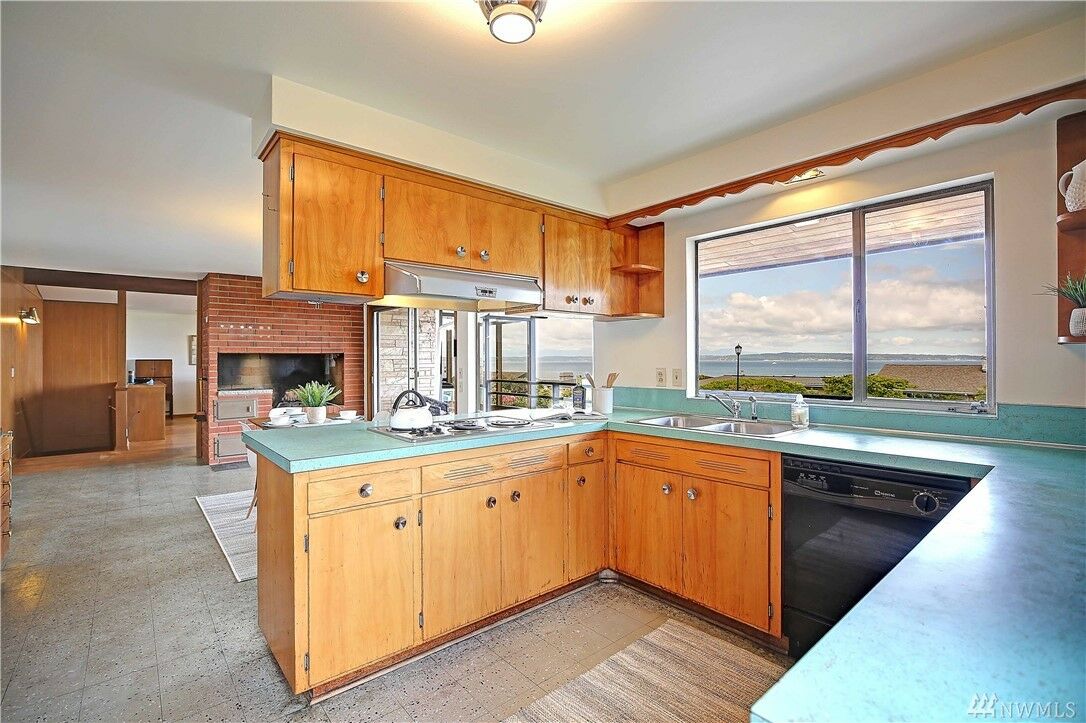
The kitchen is retro magic, and opens onto the dining room for a convivial flow throughout the entire main floor.
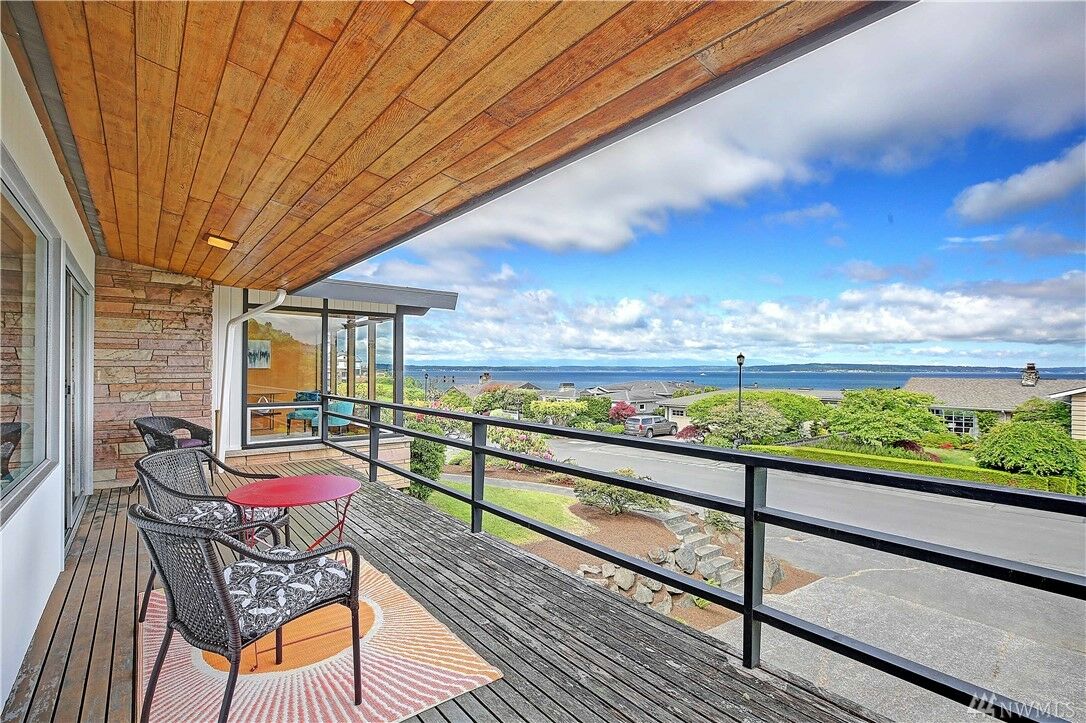
Here we have a closer look at the views offered by the home’s northwesterly orientation.
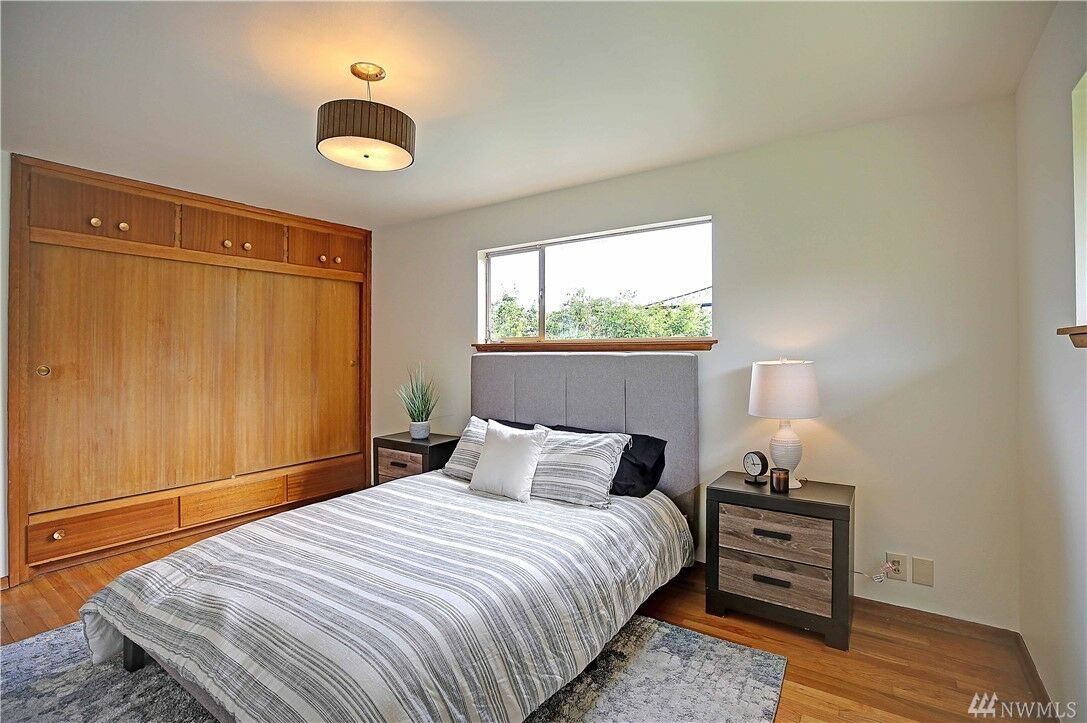
There are four bedrooms and three bathrooms. This one features an original built-in closet.
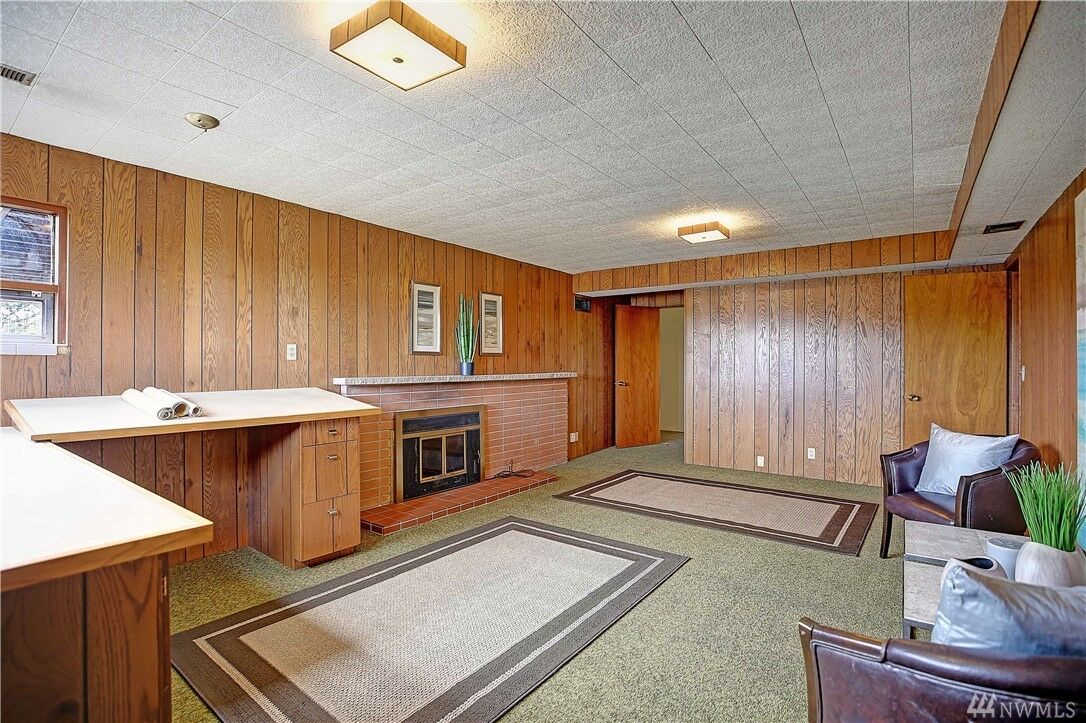
The best midcentury homes have basements meant for fun, and this one is no exception. A fireplace and classic “Mad Men” ambiance add to the charm of this lower level.
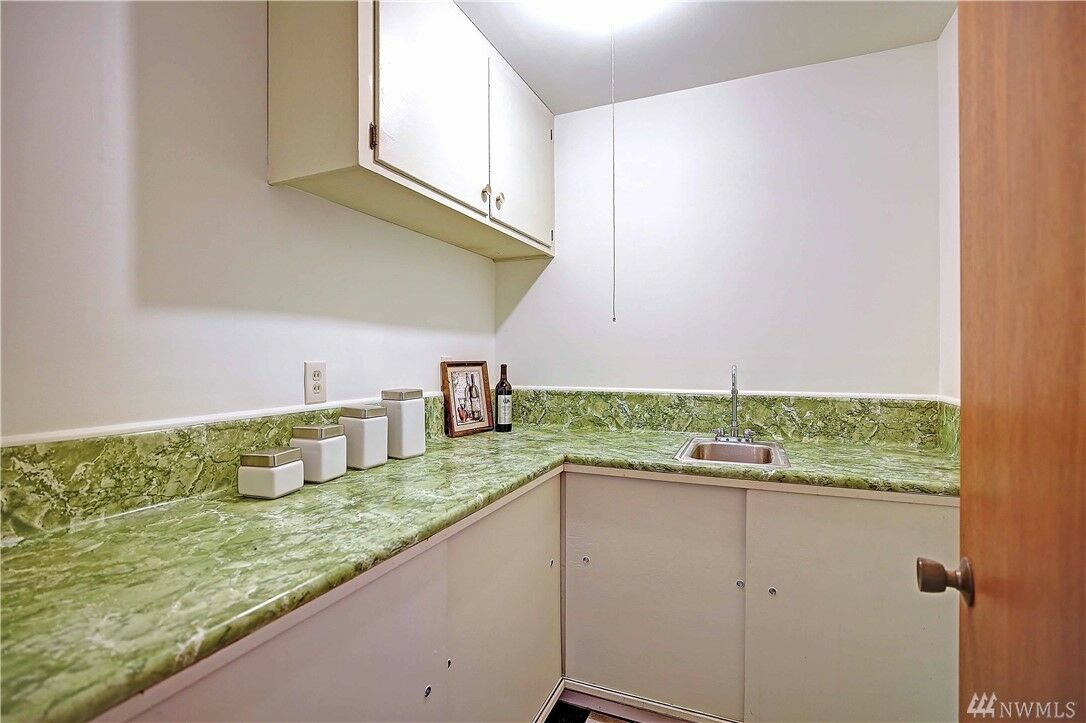
The lower level has its own kitchenette/wet bar set up.
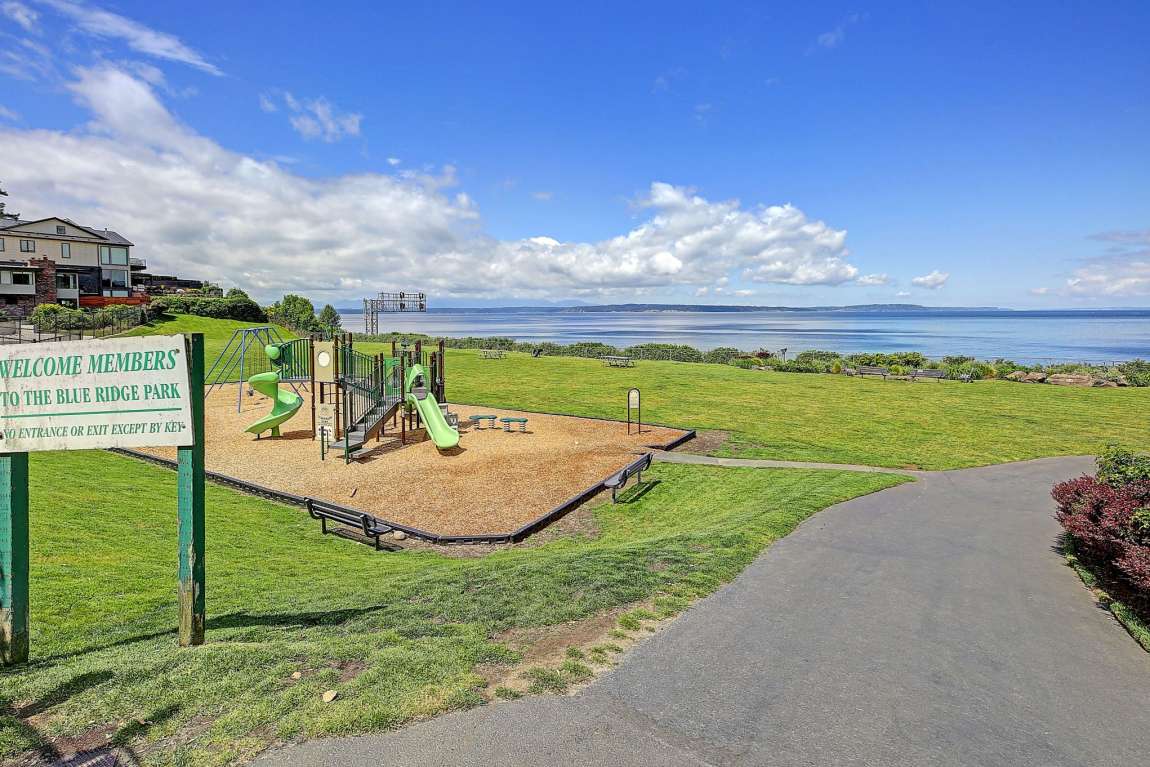
The home is part of the Blue Ridge Community which grants private access to this park, its pool, and the beach beyond.
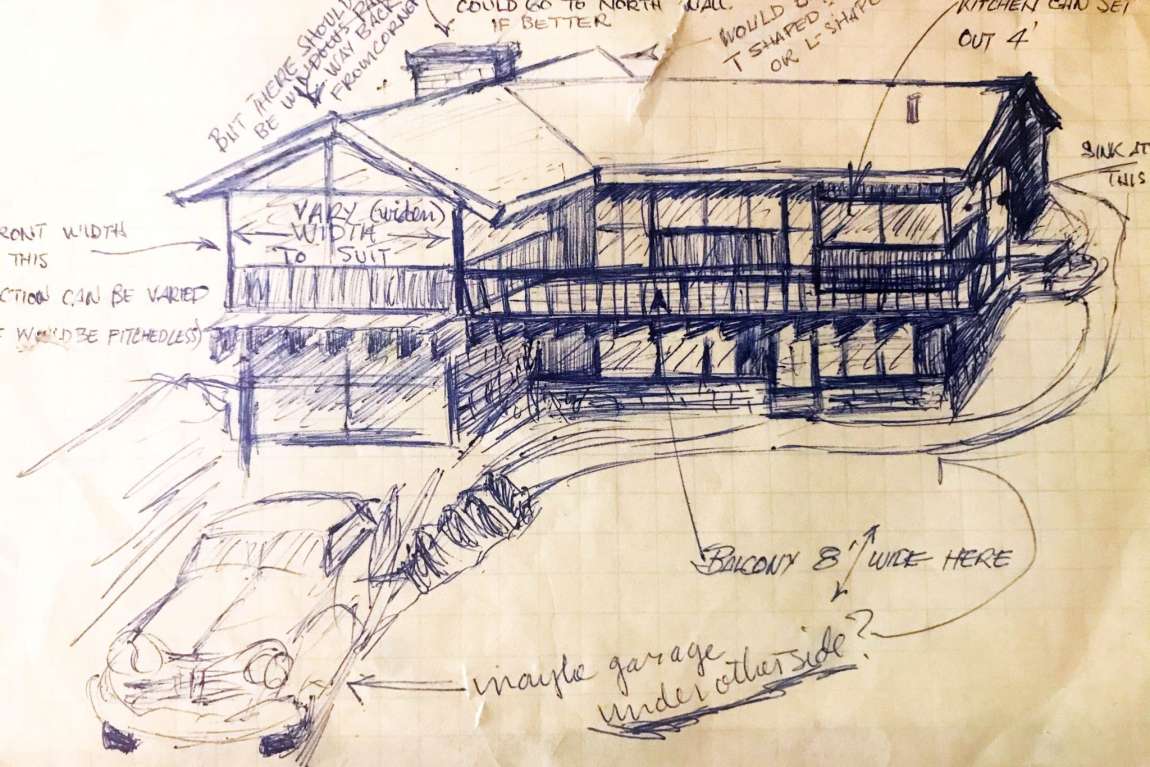
Here is Norman Overland’s original sketch for 2425 N.W. Blue Ridge.

Seattle Architect Norman Boyd Overland and his wife Rosina Mary Overland.
Written By Anna Marie Erwert
Read the full blog here – Blue Ridge midcentury modern goes on the Seattle market for first time ever
Anna Marie Erwert writes from both the renter and new buyer perspective, having (finally) achieved both statuses. She focuses on national real estate trends, specializing in the San Francisco Bay Area and Pacific Northwest.
Stanwood and Camano Island Rain Shadow

Buying a new home should be an exciting and fulfilling experience, but it can be difficult to find a place that checks all of your boxes when you have to worry about everything from cost and location to climate and weather patterns.
If you’re looking to buy your next home or finally get the vacation house of your dreams somewhere in the Pacific Northwest, it’s worth it to check out the Stanwood and Camano Island area — you might be surprised by what you find!
This special haven in the classically rainy, overcast State of Washington is actually a great location for a beach house thanks to the mountain ranges stretching along the Pacific Coast, which put Camano Island right in the middle of a rain shadow.
What Is a Rain Shadow?
Rain shadows often occur when weather systems pass perpendicularly over a range of mountains. Water condenses in the air as it rises, causing precipitation, but as winds push this humid air over and down the other side of a mountain, the warmer, dryer environment causes evaporation.
This creates an area that has consistently low levels of precipitation, or in some cases, no precipitation at all. The size of a rain shadow depends on factors such as the direction and speed of the prevailing winds, as well as the size of the range and the surrounding climate.
Rain shadows can be massive and cause extreme dryness in some places such as Death Valley, which is bordered on the west by the Sierra Nevada Mountains.
The Olympic Rain Shadow
Coastal winds from the Pacific Ocean blow inland, which would usually result in high levels of precipitation. Since these weather systems have to be pushed over the mountains, they meet warm, dry air on the way down the other side, causing the majority of the condensed water to evaporate. This prevents a great deal of rain and other precipitation from falling on Camano Island and surrounding areas, and it also helps to keep the sky clearer and allows the sun to shine more often.
Thanks to the Olympic Mountains, the Stanwood and Camano Island area get to benefit from a lower amount of rain annually. The State of Washington has an average of 40-90 inches of precipitation per year depending on location and elevation, whereas the average annual precipitation on Camano Island is under 30 inches, which is 10 inches less than Seattle!
Something that makes Camano Island’s location even more unique is that it still benefits from the moisture of the surrounding environment and stays lush and green despite the rain shadow. You get all of the beauty of the Pacific Northwest without the constant drizzle and overcast days.
If you’re looking for a beautiful place to call home or an amazing location for the beach house of your dreams, consider checking out the Stanwood and Camano Island areas to get the best of both worlds as a Pacific Northwesterner!
Knowing When to Sell Your Home

Of all the components involved in a successful home sale, there is perhaps no greater contributing factor than timing. Knowing when to sell your house gives you the best chance to make an impact when you hit the market. Every seller’s situation is unique but choosing when to sell comes down to how prepared you are, finding the right agent, and local market conditions. Once you’ve got a grasp of these elements, then you can decide if it’s the right time to sell.
Are You Ready to Sell?
Before you sell your home, your finances must be in order. Equity is a natural starting point for assessing your financial health. To calculate your equity, you’ll need to know your home’s market value. Your real estate agent can help you determine this by conducting a comparative market analysis (CMA), which involves comparing your home to others in your area by such characteristics as square footage, the number of bedrooms/bathrooms, age, and lot size. Once you know your home’s market value, subtract your current mortgage balance from that number and you’ll have your current home equity. If your equity is negative, then it may not be the best time to sell.
Beyond your home equity, there are plenty of other financial factors to consider when preparing to sell. Selling a home does not come without its own set of costs. Commission fees, home repairs, inspections, and staging are just some of the expenses you can expect to incur. For more information on the costs involved with selling your home, talk to your Windermere agent.
Selling a home is an emotional process that comes with significant lifestyle changes, so it’s important to make sure it’s the right time for you and everyone in your household. Part of a real estate agent’s’ role is understanding how the varying emotions of the selling process apply to different people. For every fear, worry, and hesitancy you may experience when trying to decide if it’s the right time to sell, your agent can share similar experiences while working with past clients.
Local Market Conditions
The state of the real estate market in your area could dictate whether it’s the right time to sell. Various factors affect local market conditions like inventory, seasonality, mortgage rates, and home price growth. Talk to your real estate agent about what the local conditions mean for your selling strategy and what kind of buyer negotiations you can expect to encounter. Agents have the tools and know-how to perform a complete analysis of the market to help you decide when the right time is to sell.
Find the Right Agent
Real estate agents are the catalyst for a successful home sale. They not only bring a wealth of resources to the table, but they can also offer helpful advice on the optimal time to sell. Agents can assess your goals for selling your home, how that aligns with your budget, and how those factors fit into the context of current local market conditions.
To truly know whether it’s the right time to sell, it’s important to find the right agent who understands the needs of your household. The more an agent knows about your situation, the better they can formulate a selling strategy. This also allows them to understand what the best offer for your home looks like. When searching for an agent, ask for referrals from your inner circle. Interview multiple agents to get an idea of their qualities, and select the one that makes the most sense for you.
When you’re ready to sell, or if you have any questions about the selling process, talk to an experienced Windermere agent here: Connect with an Agent
Market Insights | April 2021

APRIL 2021 produced a hint of good news for Buyers — sizeable increases in new listings in the Stanwood and Camano Island zip codes compared to a year ago. The new listings move into pending status so quickly that the active listing numbers do not always reflect the overall activity.
Case in point. At the end of April, our zip codes had 35 active residential listings. Yet, during the month, 120 new listings were added. This is a jump of 48% more listings added in April 2020 when the pandemic shutdown was beginning. Compared to two years ago (April 2019), the volume of new listings is up 3%.
Pending sales continue to surge keeping inventory depleted. There were 90 pending sales in Stanwood and Camano Island in April, up nearly 61% from last April’s total of 56 pending sales.
With supplies depleted, prices continue to climb in most cases. In April, 74 sales closed in our zip codes, nearly 35% more than a year ago. Year over year prices on these sales surged 20% from $507,294 to $610,902.
Although bidding wars are common, some sellers who have been pushing the envelope on their listing prices are now experiencing longer list times and, in some cases, have had to drop their prices. With things starting to return to “normal” the off-the-chart activity placing sellers in the driver’s seat may be moderating.
That said, there is still far more demand than supply. Interest rates are still low. These two factors will most likely lead to the high volume of pending sales activity continuing into the summer.
At Windermere, our responsiveness to the local market, dedication to the community, and commitment to our trade is why we help our clients sell more real estate in Stanwood and Camano Island than any other company.
We are all in, for you.
Windermere Real Estate Designated Broker | REALTOR®
Owner, Windermere Stanwood & Camano Island
360-387-HOME
.
8 Tips for a More Energy Efficient Home

Whether they are motivated by rising energy costs or a desire to cultivate a more sustainable home, homeowners are constantly searching for ways they can go green, reduce their home’s energy waste, and save money in the process. Here are some simple methods for a more energy-efficient home.
1. Determine Your Energy Output
A natural first step in your energy-efficient journey is to get a gauge of how much energy your home is currently using and where it is being used. Analyze your recent bills to get a picture of your home’s energy consumption and the habits that are tied to that level of usage. From there, you can determine what kinds of cutbacks can be made to save energy. You might also consider hiring a professional energy auditor to fully inspect your home’s energy practices and identify where there’s room for improvement.
2. Laundry Room Best Practices
Adjusting your methods in the laundry room is an easy way to make an impact on your home’s energy output. When it’s sunny, air-dry your clothes to save energy. Most of the energy consumption generated by doing laundry comes from the heating of the water, so use cold water when possible. Wait until you have a full load before running the washer to maximize your laundry room’s efficiency.
3. Install Energy-Efficient Lighting
Replacing incandescent lights with newer, more energy-efficient options is a productive step towards reducing your home’s energy waste. A change of lightbulbs is a relatively cheap solution compared to more expensive energy-saving methods like replacing appliances. Because energy-efficient lightbulbs use less energy than standard bulbs, they commonly last much longer as well.
4. Check Your Windows
Excessive air conditioning and heating are often the culprits behind wasteful energy practices. Weatherstripping and caulking your windows help to regulate the flow of air, keeping your home warmer in the colder months and cooler in the hotter months. Old, drafty windows let in air that can increase your home’s energy usage, regardless of the season. The upfront investment in purchasing new windows will pay off in the long run and will help to reduce energy waste.
5. Check Your HVAC Unit
A fine-tuned HVAC system is critical to making your home as energy efficient as it can be. Maintenance of your HVAC unit periodically to make sure it’s running in tip–top shape and to avoid replacements, which can be quite expensive. The cleaner your HVAC filters, the more efficiently they can run. The filters should be swapped out a maximum of every three months, more often if you use it year-round or if you have pets at home.
6. Insulate Your Home
A well-insulated home can deliver significant savings on heating and cooling costs. Walls and windows are common areas where air can escape, but so are pipes and ducts. Wrapping all these areas in insulation will pave the way for saving energy throughout the house.
7. Turn Down Your Thermostat
Turning down your thermostat is an effective method of reducing energy consumption. Even lowering it by one degree will lower your furnace’s energy output and can make a difference in your home’s overall energy efficiency. Remember to clean your furnace filter often. A clean filter will allow your home’s heating system to run more efficiently and cost-effectively.
8. Set Energy Efficiency Goals
Once you’ve begun to implement some of these strategies to make your home more energy-efficient, you’ll discover new ways to reduce your home’s energy waste while saving money. Set goals for your home’s overall energy output in a given month or set a target number you’d like to see on your next energy bill. Track your home’s progress in energy efficiency and the savings you’ve generated over time to see the difference you’ve made.
By Sandy Dodge
Dick’s Food Truck A Success!

On Tuesday, April 13th we hosted the Dick’s Food Truck at our Stanwood Office to raise money for the Stanwood-Camano YMCA and to bring a Seattle icon to our town for one night. We were joined by hundreds of community members and Dick’s sold 1,000 burgers!
 Customers were encouraged to “Round-Up” their purchases and donate the proceeds to the YMCA. Through the Through the “Round-Up” we raised $150, Chelsea Young of Dick’s Restaurant said, “So happy to hear this number, this is the highest roundup we have had with the truck so far.” Co-owners Randy and Marla Heagle and the Windermere Foundation will be matching that amount.

Thank you to everyone who was able to attend and support the YMCA. Because of this event as well as individual donations from the team at Windermere, the Windermere Foundation, and Co-Owners Randy and Marla Heagle, the YMCA will be able to continue their 3rd-grade swim program. This program provides essential water safety training to all of the 3rd graders in the Stanwood-Camano School District free of charge.

We are so incredibly grateful for our amazing community that made this event a success.
Market Insights | March 2021

.
We are all in, for you.
Windermere Real Estate Designated Broker | REALTOR®
Owner, Windermere Stanwood & Camano Island
360-387-HOME
.

